
Letter to Landlord About Damp and Mould
Mould on the walls is not something you have to live with. Report it to your landlord in writing, describe it clearly, and keep a dated copy. The template below does that for you.

Below is a letter you can copy, the information that makes it hard to ignore, and what to do next if your landlord does not respond.
The short version
- Your landlord is responsible for repairs to the structure, exterior, heating, water and drainage, and for keeping the home fit to live in. Serious damp and mould can make a home unfit.
- Report the problem in writing (email is fine) with photos and the date you first noticed it. A phone call is easy to forget or deny.
- Give a reasonable deadline to inspect, usually 14 days, or sooner if anyone in the home has a health condition.
- If nothing happens, contact your council’s private housing team. They can inspect and order the landlord to fix it.
- Do not stop paying rent. It puts you at risk of a possession claim on the rent arrears grounds.
Damp and mould letter template
Copy this, fill in the parts in square brackets and send it by email so you have a timestamp. Attach two or three clear photos.
[Your name]
[Address of the rented home]
[Date]

Dear [Landlord or letting agent name],

Damp and mould at [address]

I am writing to report damp and mould in the property. I first noticed it on [date]. It is in [rooms and exact places, for example the bedroom ceiling above the window and behind the wardrobe]. It covers roughly [size] and [is getting worse / keeps coming back after cleaning].

[Choose what applies: There is water coming in from / The walls are wet to the touch / The extractor fan does not work / The windows do not close properly.]

We ventilate the home, use the extractor fans and heat the rooms we use. [Anyone vulnerable: A member of the household is (pregnant / under 5 / has asthma or a lung condition), so this is affecting our health.]

Please arrange for someone to inspect the property within 14 days of this letter, find the cause and tell me in writing what work will be done and when.

I have attached photos taken on [date]. Please reply to confirm you have received this report.

Yours sincerely,
[Your name]
[Phone number]
Keep the sent email and any reply. If you post a letter instead, get a free certificate of posting from the Post Office.
What your landlord has to do
Two pieces of law do most of the work for tenants in England.
Section 11 of the Landlord and Tenant Act 1985 makes the landlord keep the structure and exterior in repair, along with installations for water, gas, electricity, sanitation and heating. Leaking roofs, broken guttering, rising damp and faulty heating all fall here. The duty starts once the landlord knows about the problem, which is why a written report matters.
The Homes (Fitness for Human Habitation) Act 2018 requires the home to be fit to live in for the whole tenancy. Damp and mould growth is one of the listed hazards. If the home is unfit, you can take the landlord to court yourself, although advice first is sensible.
Separately, councils inspect homes using the Housing Health and Safety Rating System. Damp and mould is one of the 29 hazards it scores. A serious (category 1) hazard means the council must act, usually with an improvement notice.
The Renters’ Rights Act 2025 also lets the government apply Awaab’s Law time limits, already in force for social housing, to private renting. On 8 October 2026 it opened a consultation on how to do this, which closes on 18 December 2026. Until the rules are made, the duties above are the ones that apply.
When the landlord says it is condensation
Landlords often reply that mould is caused by drying clothes indoors or not opening windows. Sometimes lifestyle plays a part, but the question is whether the home can cope with normal living. A property with a broken extractor fan, single glazing, poor insulation or a leak will grow mould even with careful tenants.
Ask the landlord to put the cause in writing after the inspection. If you disagree, ask the council for an inspection. Their assessment carries more weight than either side’s opinion.
If your landlord does not respond
- Send a short reminder after the deadline, referring to your first letter and its date.
- Contact the council private sector housing or environmental health team. Use the council complaint route finder to find the right team.
- Keep a log of every contact, photo and health effect. The evidence log builder turns notes into a dated timeline.
- Get advice from Shelter, Citizens Advice or a housing solicitor if your health is affected or you are thinking about a claim.
Since 1 May 2026 section 21 no-fault evictions have ended in England, so a landlord can no longer end your tenancy without a reason just because you complained. Possession now needs a Section 8 ground.
Free template: Damp and mould report letter
Fill in the parts in [square brackets], then copy, download as a Word file or print. Each one shows a filled-in example first.
Damp and mould report letter
Use this to report damp or mould in writing, with room-by-room details and any effect on your health.
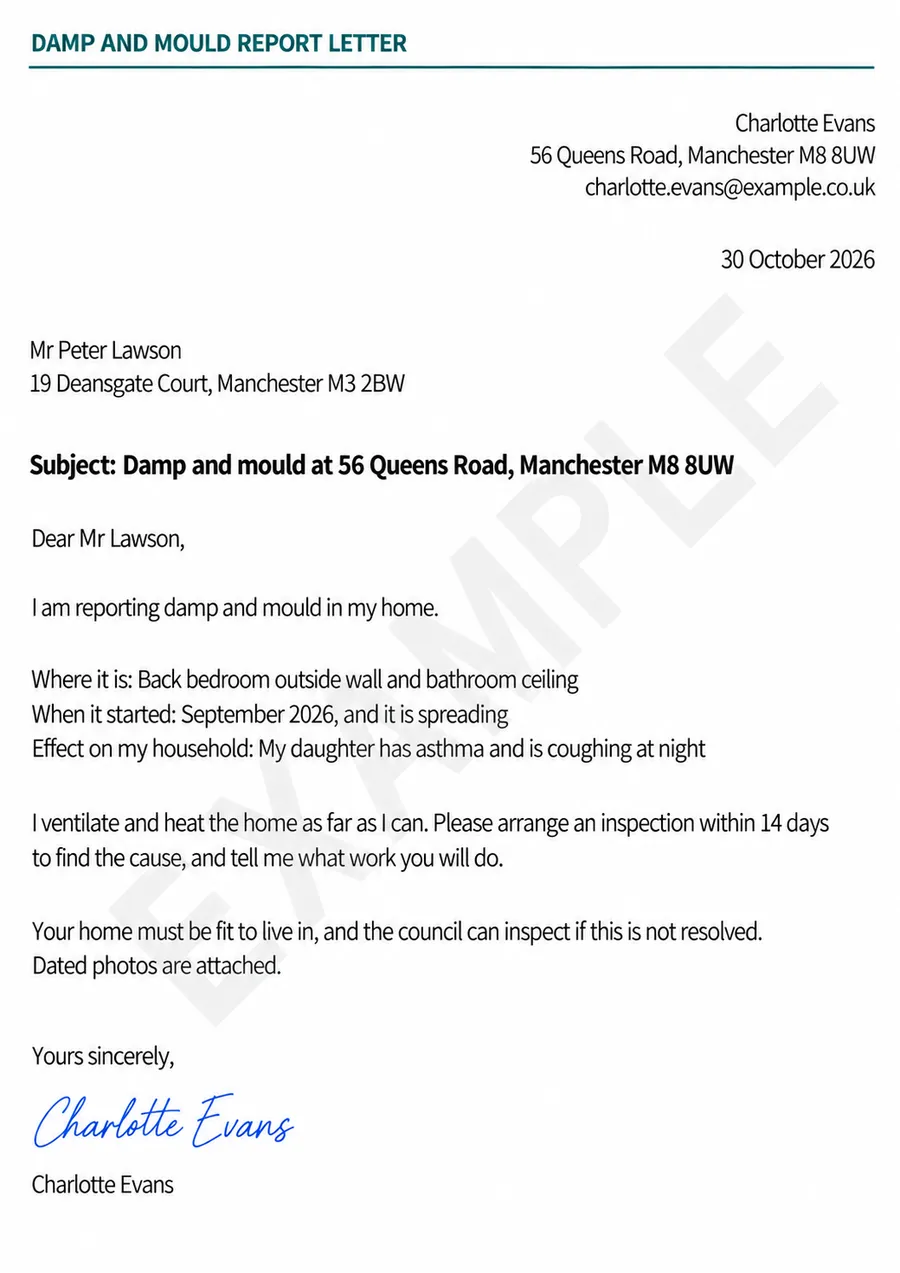
[Your name]
[Your address]
[Your email]

[Date]

[Recipient name]
[Recipient address]

Subject: Damp and mould at [Property address]

Dear [Salutation],

I am reporting damp and mould in my home.

Where it is: [Where]
When it started: [When]
Effect on my household: [Effect]

I ventilate and heat the home as far as I can. Please arrange an inspection within [Timescale] to find the cause, and tell me what work you will do.

Your home must be fit to live in, and the council can inspect if this is not resolved. Dated photos are attached.

Yours sincerely,

[Your name]
Before you send it
- Awaab’s Law timescales are not yet in force for private renting, as consultation runs until 18 December 2026.
- Photograph the affected areas on the same day each week.
- Tell your GP about any health effects so that there is a record.
Checked against: GOV.UK: Private renting, repairs
Sources
Questions people ask
How long does a landlord have to fix damp and mould?
There is no single fixed deadline for private tenancies in every case. The landlord must act within a reasonable time once they know about it, and faster when the problem is serious or affects health. Check GOV.UK for whether Awaab’s Law timescales now apply to private renting.
Can I withhold rent until the mould is fixed?
It is risky. Unpaid rent can lead to a possession claim on the rent arrears grounds. Use written complaints, the council and advice services instead.
Who pays for mould damage to my belongings?
If the mould comes from a disrepair the landlord failed to fix after being told, you may be able to claim compensation for damaged belongings. Keep receipts and photos and get advice.
Can my landlord evict me for complaining about mould?
Section 21 no-fault evictions ended in England on 1 May 2026. A landlord now needs a Section 8 ground, and complaining about repairs is not one.
Should I clean the mould myself?
Wiping small patches with a mould remover is reasonable, but photograph it first so you keep evidence. Cleaning does not fix the cause, so still report it.


