
Does My Rental Need a Landlord Licence?
Whether you need a licence depends on the property, who lives there and your council. Some boroughs license almost every private let; others only license large shared houses.

Work out which of the three schemes could apply, then confirm it on your council’s website before the tenancy starts.
The three types of licensing
| Scheme | Applies to | Where |
|---|---|---|
| Mandatory HMO licensing | Homes with 5 or more people from 2 or more households sharing a kitchen, bathroom or toilet | Everywhere in England |
| Additional HMO licensing | Smaller HMOs, often 3 or 4 sharers | Only where the council has declared a scheme |
| Selective licensing | Ordinary single-household lets | Only in streets or wards the council has designated |
Schemes run for up to five years and councils consult before starting or renewing them, so the answer for your address can change.
How to check your council’s schemes
- Find your council using the GOV.UK find your local council service.
- Search the council’s website for “property licensing” or “selective licensing”. Most publish a map or postcode checker.
- Check the start and end dates of each scheme and whether your street is inside it.
- Read the licence conditions. They usually cover safety certificates, waste, anti-social behaviour and maximum occupants.
- Apply before the tenancy starts. Letting while an application is pending is usually allowed; letting without applying is not.
London boroughs such as Merton, Newham, Waltham Forest and Brent have run wide schemes, but coverage changes as schemes end and new ones are approved, so always confirm on the council’s own site.
What happens if you let without a licence
- The council can prosecute or issue a civil penalty instead. Penalties were raised under the Renters’ Rights Act 2025.
- Tenants can apply for a rent repayment order to claim back rent paid while the property was unlicensed.
- Some possession routes may be restricted while the property is unlicensed.
For tenants: how to check your landlord
Councils keep a public register of licensed properties. If your home should be licensed and is not on the register, you can report it to the council’s private housing team. Use the rent repayment order checker to see whether you may be able to claim rent back.
Free template: Property licence check record
Fill in the parts in [square brackets], then copy, download as a Word file or print. Each one shows a filled-in example first.
Property licence check record
Record what you found when checking whether a property needs a licence.
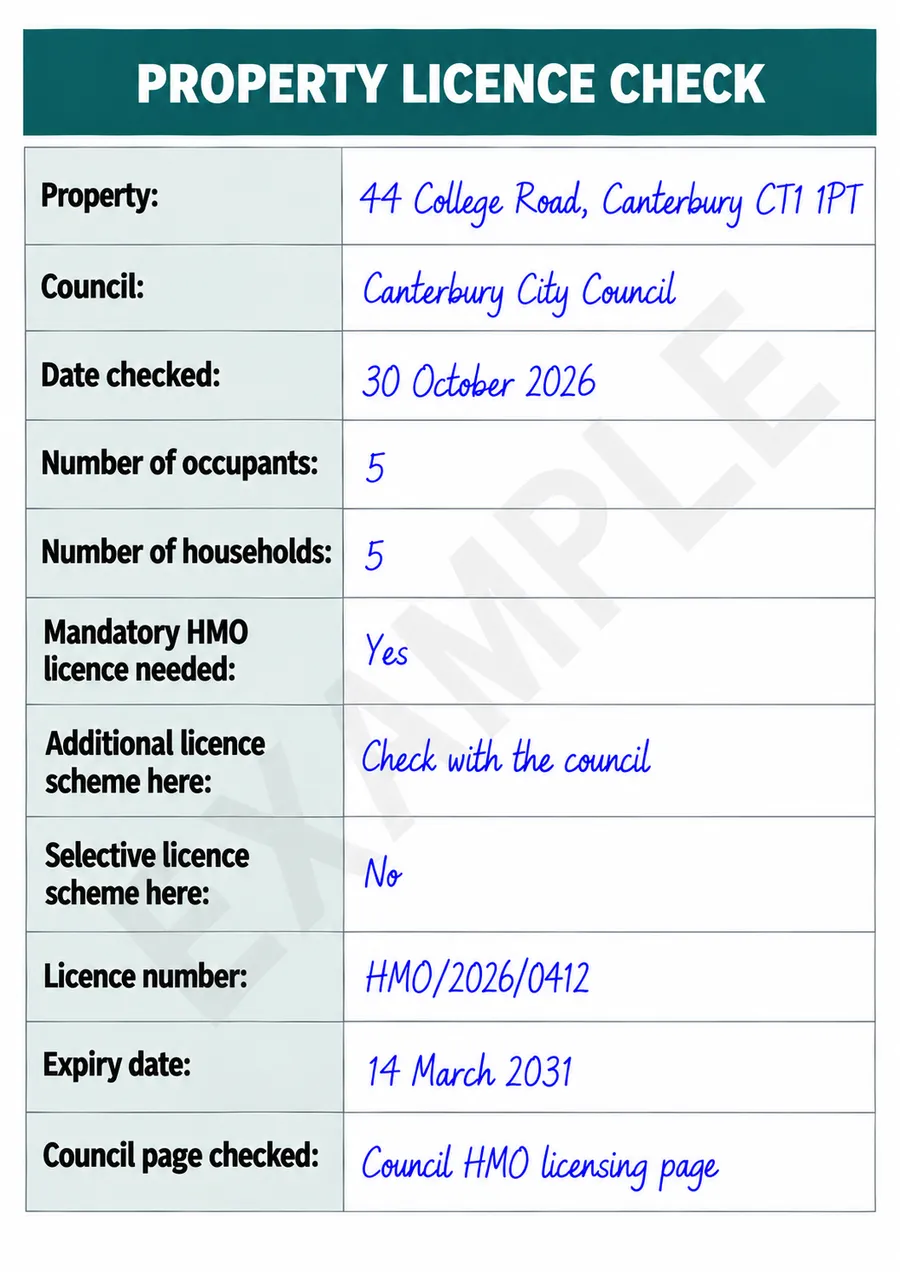
PROPERTY LICENCE CHECK

Property: [Property address]
Council: [Council]
Date checked: [Date]

Number of occupants: [Occupants]
Number of households: [Households]
Mandatory HMO licence needed: [HMO]
Additional licence scheme here: [Additional]
Selective licence scheme here: [Selective]
Licence number: [Number]
Expiry date: [Expiry]
Council page checked: [Page]
Before you send it
- Schemes change. Check the council’s website each time.
- Letting without a required licence is an offence.
- A tenant may be able to apply for a rent repayment order.
Checked against: GOV.UK: Find your local council
Sources
Questions people ask
Is a selective licence the same as a landlord registration?
No. Licensing is run by councils for particular areas. The national private rented sector database created by the Renters’ Rights Act is a separate registration for all landlords.
How much does a landlord licence cost?
Each council sets its own fee, usually several hundred pounds per property for a five-year licence, with discounts for early applications or accredited landlords in some areas.
Does a licence cover my letting agent?
The licence holder is usually the landlord or the person receiving the rent. Agents can hold it, but the landlord stays responsible for letting an unlicensed property.
Can I let a room to a lodger without a licence?
Usually yes. A home where the owner lives with one or two lodgers is not normally an HMO, but check the council’s rules. Check actual occupancy and household arrangements before relying on an exemption. If more people move in or the owner moves out, revisit the position with the council because the facts have changed.
Where do I find the public register?
Most councils publish their register of licences online, or will provide it on request. Search using the full property address and check what licence category the register covers. If no result appears, ask the licensing team about applications and exemptions before concluding the property is unlicensed.


