
Types of Tenancy in the UK
Your tenancy type decides how much notice you get, how rent can rise and how you can be asked to leave. It depends mostly on where you live, who your landlord is and when you moved in.

Start with your nation, then check the details. If you are still unsure, the tenancy type checker walks you through it.
Tenancy types at a glance
| Nation | Most private renters | Other common types | Main law |
|---|---|---|---|
| England | Assured periodic tenancy (from 1 May 2026) | Lodger or licence; older regulated tenancies; social secure and assured tenancies | Housing Act 1988 as amended by the Renters’ Rights Act 2025 |
| Wales | Standard occupation contract | Secure contract (social landlords); lodgers | Renting Homes (Wales) Act 2016 |
| Scotland | Private residential tenancy (since 1 December 2017) | Older assured and short assured tenancies; lodgers | Private Housing (Tenancies) (Scotland) Act 2016 |
| Northern Ireland | Private tenancy | Protected and statutory tenancies; lodgers | Private Tenancies (NI) Order 2006 and Private Tenancies Act (NI) 2022 |
England after 1 May 2026
The Renters’ Rights Act 2025 turned almost every private tenancy in England into an assured periodic tenancy on 1 May 2026. Fixed terms and assured shorthold tenancies no longer exist for private renting. If you had an AST, it converted automatically. You did not need to sign anything new.
In practice that means you can leave with two months’ notice, your landlord can only end the tenancy using a Section 8 ground, and rent can rise once a year using a Section 13 notice.
A few arrangements sit outside this:
- Lodgers who share the home with a resident landlord are usually excluded occupiers with far fewer rights. The landlord only has to give reasonable notice, often the length of the rent period.
- Regulated tenancies that began before 15 January 1989 keep their own protections, including fair rents set by the rent officer.
- Social tenants of councils and housing associations have secure or assured tenancies with separate rules.
- Some lettings such as holiday lets, student halls run by universities and business tenancies are not assured tenancies at all.
Wales: occupation contracts
Since 1 December 2022, tenants in Wales are called contract-holders and have occupation contracts. Private landlords use a standard occupation contract; council and housing association tenants usually have a secure contract. Landlords must give a written statement of the contract within 14 days of the start.
For a no-fault notice on a periodic standard contract, landlords must normally give at least six months’ notice, and cannot serve it in the first six months of occupation.
Scotland: private residential tenancies
Any private let that started on or after 1 December 2017 is a private residential tenancy. It is open-ended: there is no fixed end date and the landlord can only end it using one of 18 eviction grounds through the First-tier Tribunal. Tenants give 28 days’ notice to leave.
Tenancies that started before that date may still be assured or short assured tenancies.
Northern Ireland: private tenancies
Most private renters in Northern Ireland have a private tenancy under the 2006 Order. Changes from the Private Tenancies Act (NI) 2022 include longer notice periods from landlords, a limit on deposits of one month’s rent and a cap of one rent increase in any 12 months.
How to tell which one you have
- Where is the home? Tenancy law is different in each nation, so this comes first.
- Does your landlord live there? If you share a kitchen or bathroom with a resident landlord, you are probably a lodger.
- Who is the landlord? A council or housing association means a social tenancy.
- When did it start? Very old tenancies (before 1989 in England) may be regulated.
- What does the paperwork say? The label on an agreement does not decide the type on its own, but dates and terms help.
The tenancy type checker asks these questions in order and explains the rights that follow.
Free template: Tenancy type notes
Fill in the parts in [square brackets], then copy, download as a Word file or print. Each one shows a filled-in example first.
Tenancy type notes
Note the facts that decide your tenancy type before you use the checker or speak to an adviser.
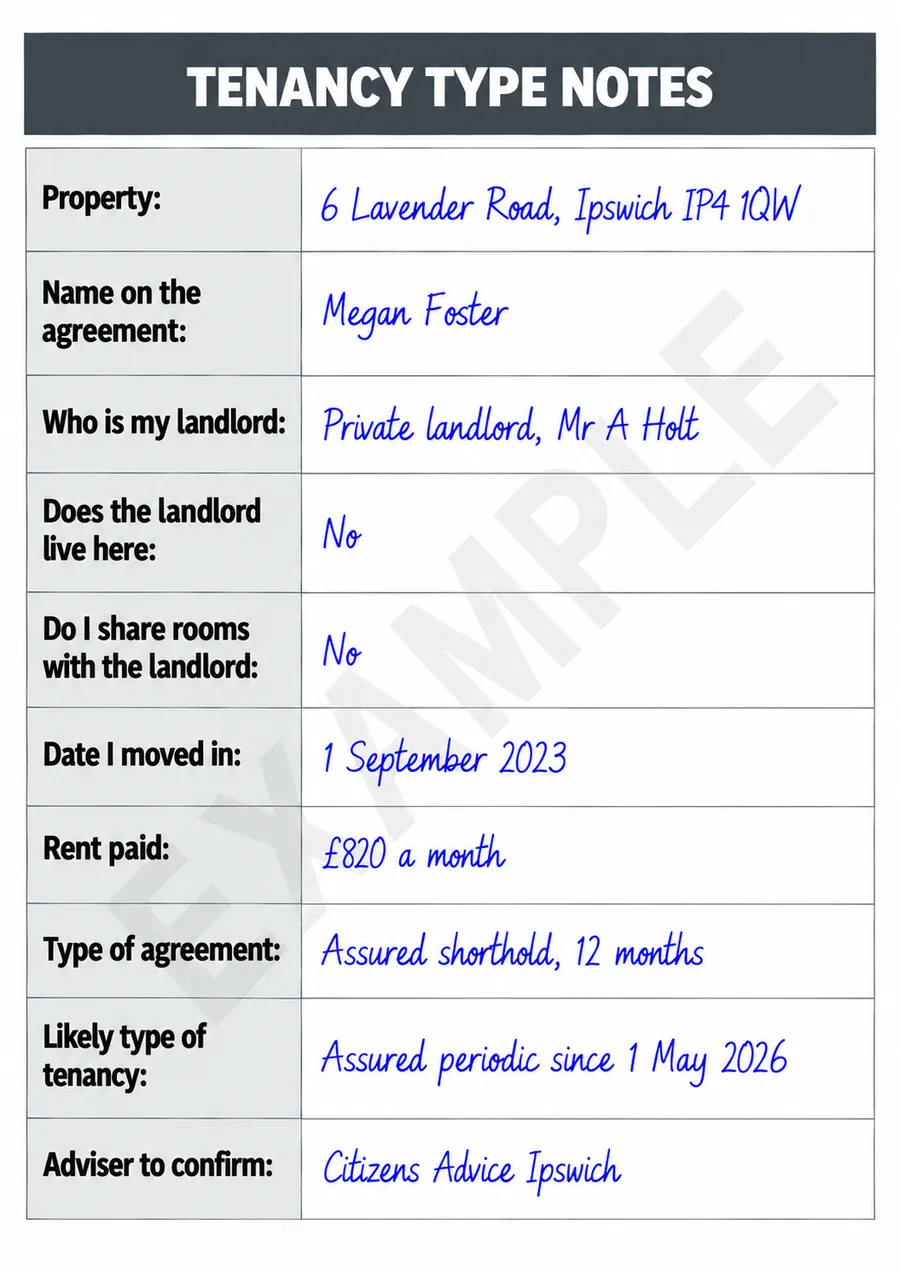
TENANCY TYPE NOTES

Property: [Property address]
Name on the agreement: [Name]

Who is my landlord: [Landlord]
Does the landlord live here: [Resident]
Do I share rooms with the landlord: [Share]
Date I moved in: [Moved]
Rent paid: [Rent]
Type of agreement: [Agreement]
Likely type of tenancy: [Type]
Adviser to confirm: [Adviser]
Before you send it
- Lodgers and some sharers have different rights.
- Council and housing association tenancies have their own rules.
- Bring these notes to an adviser.
Checked against: GOV.UK: Renters' Rights Act overview for tenants · Shelter England: Private renting advice
Sources
Questions people ask
Do assured shorthold tenancies still exist?
Not for private renting in England. Existing ASTs became assured periodic tenancies on 1 May 2026. Wales, Scotland and Northern Ireland never used ASTs in the same way.
Is a lodger a tenant?
Usually not. A lodger who lives with a resident landlord is normally an excluded occupier or licensee, with fewer rights than a tenant. Whether the landlord actually lives there and which rooms you share matters more than the label alone. Check those facts and the agreement before assuming the notice and eviction rules for a lodger apply.
What tenancy do most renters in England have now?
An assured periodic tenancy, which rolls on with no fixed end date until the tenant gives notice or the landlord uses a Section 8 ground. Check exceptions first, including resident-landlord, social housing and some student arrangements. The property facts and agreement matter; the general reform should not be used to assume that every person renting a room has the same status.
Does the name on my agreement decide my tenancy type?
No. The real arrangement matters more than the label. A document called a licence can still create a tenancy. Gather evidence of who lives at the property, the space you control and any services provided. The checker can help organise those facts, but a disputed legal status may need professional assessment.
Which tenancy type gives the most security?
Social secure tenancies and older regulated tenancies are usually the most secure. Among private lets, Scottish private residential tenancies and English assured periodic tenancies are both open-ended.


