
Letting Agent Compliance Checklist
A letting agent in England has its own legal duties on top of the landlord’s. If something goes wrong, the agent needs to show what it did and when. This checklist covers what the agent must have in place, what it must do for each let and the records that prove it.

It is written for agents and for landlords who want to check the agent they use. Tenants can use it too, for example to see whether a fee or a missing document is something to raise.
This is a working checklist for private lettings in England. It does not replace advice from your redress scheme, your client money protection provider or a solicitor.
What the agency must have in place
These apply to the business as a whole, not to each property. A council can fine an agent that lets or manages property without them.
- Redress scheme membership. Every letting and managing agent must belong to a government-approved scheme, currently The Property Ombudsman or the Property Redress Scheme. Show the scheme name on your website and in your office.
- Client money protection (CMP). If you hold rent or deposits for clients, you must belong to an approved CMP scheme and display the certificate.
- Published fees. Your full list of fees to landlords and the permitted payments for tenants must be on your website and visible in your office, including VAT.
- Anti-money laundering. Agents handling lets with a monthly rent of 10,000 euros or more must register with HMRC for supervision.
- Data protection. Register with the ICO if you process tenant data, and have a retention policy for references and ID.
Adverts and applications
Since 1 May 2026, the rules on how a home is marketed have become stricter.
- State one asking rent. You must not invite, encourage or accept offers above it. A range or “offers over” is a breach.
- Do not use wording that puts off people who receive benefits or have children, such as “no DSS” or “professionals only”. Blanket bans are now unlawful.
- Include the material information buyers and renters need: rent, deposit, council tax band, EPC rating and any known issues such as restricted parking or flood risk.
- Ask for no more than one week’s rent as a holding deposit, and explain in writing when it can be kept.
- Carry out right to rent checks for every adult who will live there and keep a dated copy of the check.
Keep a copy of each advert as it appeared on each portal, with the date. If a complaint comes in later, the saved advert is your evidence.
Fees, deposits and rent in advance
The Tenant Fees Act 2019 still controls what a tenant can be charged. The permitted payments are rent, a refundable deposit of up to five weeks’ rent (six weeks if the annual rent is £50,000 or more), a holding deposit, defined default fees, a £50 fee for agreed changes and early termination costs. Anything else is a banned payment.
Rent in advance is now limited. Before the tenancy starts, a tenant can be asked for no more than one month’s rent once the agreement is signed. Check your onboarding process does not ask for two or three months up front.
Deposits must be protected in an approved scheme within 30 days, and the prescribed information must reach the tenant within the same 30 days. Keep proof that it was sent, not only the scheme certificate.
Starting each tenancy
For each new let, the file should contain:
- The written statement of tenancy terms required for new assured periodic tenancies.
- Gas safety record (annual), electrical installation condition report (every five years) and EPC (rating E or above unless exempt).
- Proof that smoke alarms are fitted on every storey and carbon monoxide alarms are in rooms with a fixed combustion appliance, tested on day one.
- The property licence, if the council requires one. Check HMO, additional and selective licensing schemes for the address.
- A dated inventory with photos, signed or acknowledged by the tenant.
For tenancies that already existed on 1 May 2026, the landlord had to give the government’s Renters’ Rights Act Information Sheet by 31 May 2026. If you manage those lets and it was missed, send it now and record the date.
During the tenancy
Most complaints come from things that happen months into a tenancy. The common ones are repairs, rent increases, pets and access.
- Repairs. Log every report with the date received, the action taken and the date it was finished. Damp and mould reports need a prompt inspection.
- Rent increases. Use Form 4A under section 13, give at least two months’ notice and do not increase more than once a year. Rent review clauses in the agreement no longer work.
- Pet requests. Reply in writing within 28 days. A refusal needs a genuine reason the landlord can explain.
- Access. Give at least 24 hours’ written notice for visits, except in an emergency.
Notices and the end of a tenancy
Section 21 can no longer be used. A landlord who wants possession must serve Form 3A under section 8 and rely on a specific ground, with the right notice period. If you prepare notices for landlords, check the ground, the dates and the method of service each time, and keep proof of service.
When the tenancy ends, return the deposit promptly. Any deductions need evidence from the check-in and check-out reports. Unclear deductions are one of the main causes of scheme disputes.
A simple quarterly audit
Pick five live tenancies at random every three months and check each file against the list above. Note what was missing and who fixed it. A short audit log like this is the best way to show a council or the redress scheme that problems are found and dealt with, not ignored.
Example: an agency in Leicester checked five files in March and found two where the EICR had expired the month before. It booked electricians the same week and added a calendar reminder 60 days before each expiry date. When a tenant later complained, the agent could show the gap was found and closed within days.
Free template: Letting agent compliance checklist
Fill in the parts in [square brackets], then copy, download as a Word file or print. Each one shows a filled-in example first.
Letting agent compliance checklist
A branch-level check of the main rules for letting agents in England.
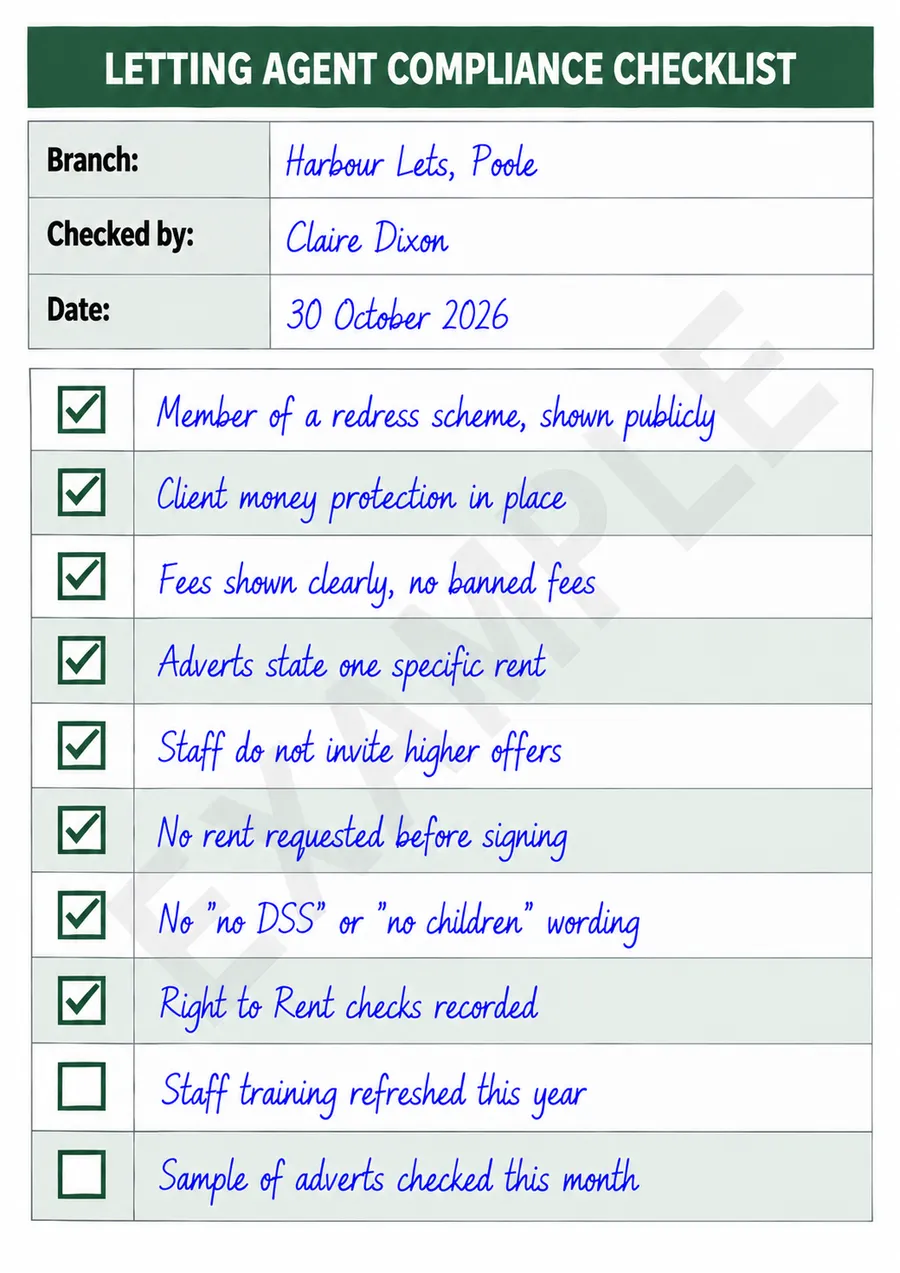
LETTING AGENT COMPLIANCE CHECKLIST

Branch: [Branch]
Checked by: [Checker]
Date: [Date]

☑ Member of a redress scheme, shown publicly
☑ Client money protection in place
☑ Fees shown clearly, no banned fees
☑ Adverts state one specific rent
☑ Staff do not invite higher offers
☑ No rent requested before signing
☑ No "no DSS" or "no children" wording
☑ Right to Rent checks recorded
☐ Staff training refreshed this year
☐ Sample of adverts checked this month
Before you send it
- Sample real adverts and messages, not just your policies.
- Keep a record of each check.
- Take legal advice on any specific complaint.
Checked against: GOV.UK: Assured periodic tenancies, a guide for landlords
Sources
Questions people ask
Can a letting agent charge a tenant a referencing fee?
No. Referencing, admin and check-out fees were banned by the Tenant Fees Act 2019. The agent must recover those costs from the landlord.
Who is responsible if the agent forgets to protect the deposit?
Both the landlord and the agent can be responsible. The tenant can bring a claim against either, and the landlord usually remains liable even if the agent made the mistake.
Does an agent need to belong to a redress scheme if it only finds tenants?
Yes. Let-only agents must belong to a redress scheme too. Client money protection applies if the agent holds client money.
Can a letting agent serve a rent increase or possession notice?
Yes, an agent can serve notices on the landlord’s behalf if authorised. The landlord is still responsible if the notice is wrong, so both should check the form, dates and ground before it goes out.
Can an agent advertise “no benefits” or “no children”?
No. Those blanket rules are unlawful from 1 May 2026, and the agent can be fined as well as the landlord.
What records should a landlord ask the agent for?
Copies of the safety certificates, deposit certificate and prescribed information, right to rent checks, the tenancy terms given, proof of service for each notice, the inventory and the repair log.
What should tenants ask a letting agent for?
The agent’s redress scheme, a copy of the deposit certificate and prescribed information, the gas safety record, EICR and EPC, and the written tenancy terms.
Can a landlord rely completely on the agent?
No. Many duties sit with the landlord by law. A good agent reduces the risk, but the landlord should still check the file at least once a year.


