
Local Authority Enforcement in Private Renting
Councils in England are the main enforcers of private renting law. They inspect homes, serve notices, issue fines and can take landlords to court. The Renters’ Rights Act gave them stronger powers and higher penalties from 1 May 2026.

This page explains what a council can do, what usually happens after a complaint and how tenants and landlords can work with the process.
Each council organises its teams differently. The team may be called private sector housing, environmental health or housing standards.
What councils can do
- Inspect a home using the Housing Health and Safety Rating System, which looks at hazards like damp, cold, fire and falls.
- Serve notices, such as an improvement notice requiring repairs by a deadline, or a prohibition order stopping use of part of a home.
- Fine landlords and agents. Most civil penalties go up to £7,000, and up to £40,000 for repeated or serious breaches.
- Licence HMOs and, in some areas, all private rentals, and take action against unlicensed lets.
- Prosecute for offences like illegal eviction.
- Apply for rent repayment orders where housing benefit or Universal Credit paid the rent.
What usually happens after a complaint
- The tenant reports the problem to the landlord first, in writing, unless it is an emergency.
- If it isn’t fixed, the tenant contacts the council with photos and the dates it was reported.
- An officer may contact the landlord informally or arrange an inspection.
- If serious hazards are found, the council can serve a formal notice.
- If the landlord doesn’t comply, the council can fine, carry out the work and recharge, or prosecute.
Protection from retaliation
Landlords must not try to evict a tenant because they complained. With Section 21 gone, a landlord needs a valid section 8 ground, and the court will look closely at a notice served soon after a complaint.
For landlords
Respond quickly to council contact, give access for inspections and keep records of repairs. Most cases close informally when the landlord acts promptly. Councils also run landlord forums and accreditation schemes that are worth joining.
Worked example
Dan in Wakefield had no working heating for three weeks in January. His landlord stopped answering. Dan emailed the council’s private housing team with his log of messages and photos of the boiler error code. An officer phoned the landlord the next day. When nothing happened, the council served an improvement notice. The boiler was replaced within the deadline.
Free template: Letter chasing a council about enforcement
Fill in the parts in [square brackets], then copy, download as a Word file or print. Each one shows a filled-in example first.
Letter chasing a council about enforcement
Use this when you have reported a problem to the council and need an update on inspection or enforcement.
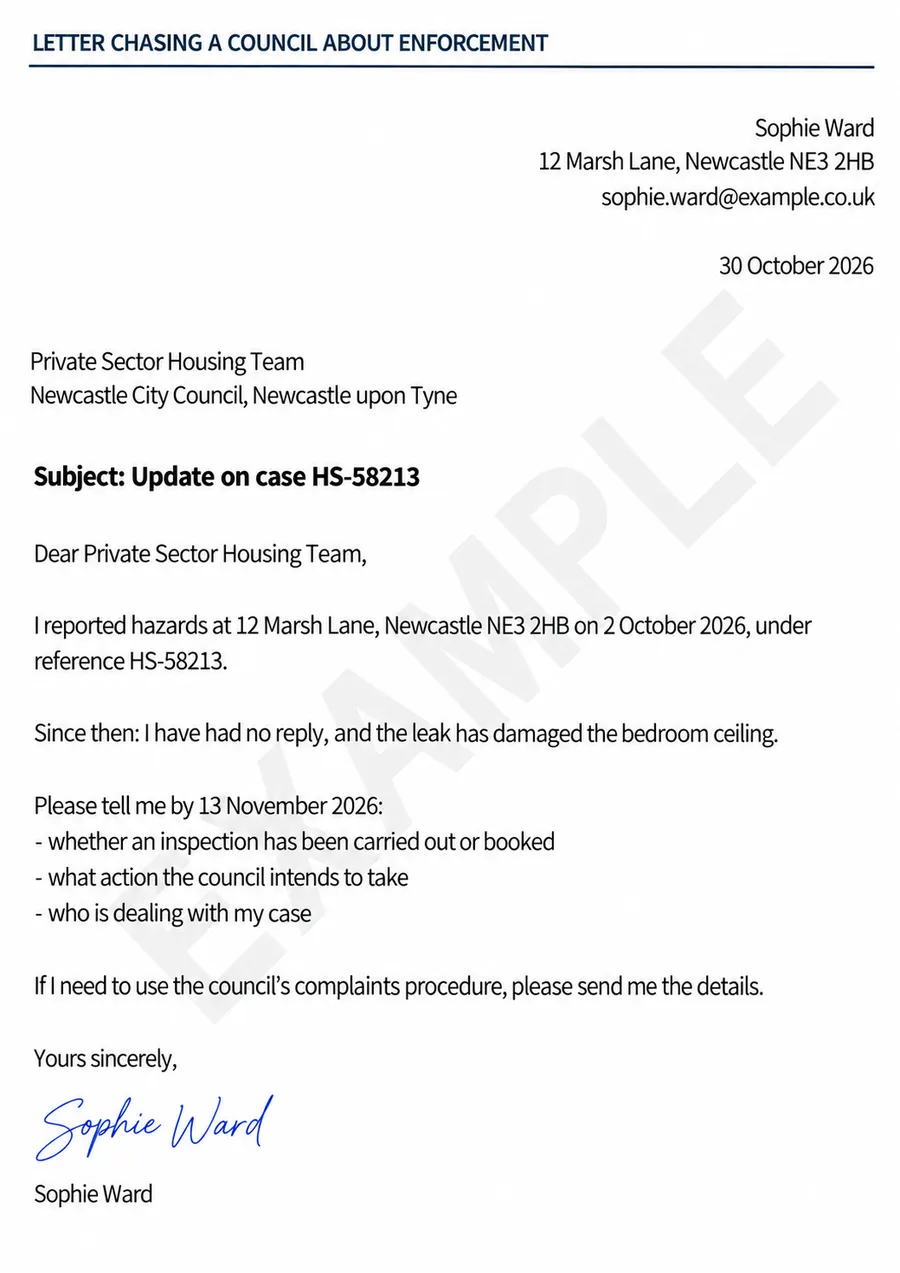
[Your name]
[Your address]
[Your email]

[Date]

[Recipient name]
[Recipient address]

Subject: Update on case [Reference]

Dear [Salutation],

I reported hazards at [Property address] on [Reported], under reference [Reference].

Since then: [What has happened]

Please tell me by [Reply date]:
- whether an inspection has been carried out or booked
- what action the council intends to take
- who is dealing with my case

If I need to use the council’s complaints procedure, please send me the details.

Yours sincerely,

[Your name]
Before you send it
- Stay polite. Officers have heavy caseloads.
- Point out any new risk or vulnerable person.
- The Local Government and Social Care Ombudsman may help after the council’s own complaints process.
Checked against: GOV.UK: Find your local council
Sources
Questions people ask
Does a council inspection cost the tenant anything?
No. Councils inspect free of charge. The landlord may be charged for formal notices.
Can the council force my landlord to fix damp?
Yes, if the inspection finds a serious hazard. It can serve an improvement notice with a deadline.
Can I complain anonymously?
You can ask the council to keep your details confidential, but for an inspection of your home they will usually need to contact you.
Can the council help if I am locked out?
Yes. Many councils have tenancy relations officers who can contact the landlord, and illegal eviction is a criminal offence.
Can the council help with rent increases or deposit disputes?
Not usually. Rent increases go to the tribunal and deposit disputes to the scheme.
What happens if the landlord ignores the council?
The council can fine, do the work itself and recharge the landlord, or prosecute.
Can council action help with a rent repayment order?
Yes. Evidence of a licensing offence or an ignored improvement notice can support an RRO application.


